
Why maths ?
Before you start, it doesn't matter if you work alone or in groups at the solutions. However, if you work in a group ensure that not some people create the solution and others still don't understand the basic steps.
Let's begin with the "Aunt Hilda" problem. It is basically a linear system of equations, you probably have heard of that at school, if you can remember. Probably at little bit more complicated. Now the steps :
- First you should define the variables which are needed for this problem. To make it easier to compare to the solution later on these are given here, first we chose t for the number of days the team is waiting before they start to shovel and m for the amount of snow falling per day. And we refer with a, b and c to the amount of snow the three groups shovel.
- with these variables, we basically have three different equations which look like a = 1/4 ( mt + 8m )
- now we try to calculate the amount one person shovels for each of these equations, and through equating we can calculate all of the variables
These are all hints. If you have come to a result compare it to the solution.
Now the second problem, which is really more complex and needs a little bit more than only school mathematics. You should have heard the expression matrices before to understand this solution.
Assuming the worst case, you don't know what matrices are. Well, one of my math teachers at school used to say : " Mathematics is the art of being lazy ". With this fundamental understanding of mathematics we now look at parts of a common maths task.
3x + 2y + 5z
= 7
5x + 4y + 8z = 9
2x + 6y + 9z = 4
Now the mathematician, after writing pages over pages which look similar to that is asking himself, why do have to write always x, y and z. It is obvious where they have to be (a real mathematician would say they are redundant, but that doesn't matter). So now he writes just the following.
( 3 2 5 | 7
)
( 5 4 8 | 9 )
( 2 6 9 | 4 )
It's representing the exact same thing, but he saved himself to write 9 times a character, isn't that great ? And there are now standard procedures how you can solve the represented linear equation system. In general you can do elementary row and column operations to facilitate the matrix without changing the represented problem. And as mentioned, there is a standard way to solve all these problems represented in matrices, it is called Gaussian Elimination. However, sometimes this standard way can get really nasty with loads of fractions like 57/941 or similar, so if you calculate without a computer program it is not always the best way.
If you have already clicked on a link above, you see that it looks much more complicated there. That is because real mathematicians don't like numbers. They always use variables and represent the general way. So a general matrix is represented by elements which all have two indices, the first one is standing for its row position, the second one for it's column position. Which then looks similar to the following :
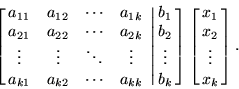
To be even more general, they don't have a specific amount of rows or columns, they indicate this by variables as indices for the last elements. To show the connection between the small introduction example and this general matrix : the b values are the last column, the a values are all the coefficients of the variables and x,y and z would be x one till x with index k.
To make it even more nasty, there are operations like multiplication of matrices allowed. How it works can be seen here, Matrix Multiplication.
Some other links here where you can look if you can't understand a explanation in a linked page further down. Read about transposed and symmetric matrices, maybe this helps.
Now we come to a topic which is referred to as linear homomorphism, but as this WebQuest can't refer to all mathematical definitions it uses here will just be a description of what you have to do to solve the task. It basically means that you can create a matrix, which creates the next situation of the students if you multiply it with the current situation of the students. To make this work, the situation of the students has to be represented by a vector. Such matrices are called transformation matrices.
After this broad introduction now more briefly the steps how you can solve this task :
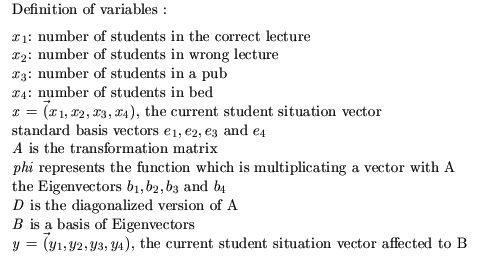
- define A and phi
- determine the Eigenvalues of A. To do this you need to know how to calculate a Determinant.
- a little help here, as you found four Eigenvalues, the matrix is diagonalizable. The diagonalized matrix D is a matrix with only zeros except the diagonal which consists of the four Eigenvalues.
- D is the transformation matrix of phi affected to any basis of Eigenvectors. For our purpose it is enough if you just know that this basis is a matrix with the four Eigenvectors as its columns. ( the basis we have worked on before was the standard basis, which consisted out of the four standard basis vectors and consists of zeros except the diagonal which has four one's on it).
- Now we have to solve By = x to gain the number of students at the beginning affected to B. (If we are doing this we can use D to calculate phi, instead of using A, which would be much more complex)
- Finally (D^n)*y gives us the current situation after n lectures.
- Still to answer the additional part of the task, how it would change if the beginning situation would change, but if you made it till here this should be possible for you now
Possibly you didn't come to a solution. But no problem, you can look at the solution here.
If you have done the tasks go to the evaluation page and see how you should represent what you have learned.
Last updated : 24.2.2004
Site
build : 16.2.2004
contact
: maolra9@yahoo.de