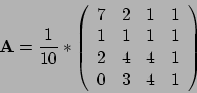
..
.. .
After this definition we can define that represents
the state that all students go to the correct
lecture.
.
After this definition we can define that represents
the state that all students go to the correct
lecture.
 means that 100% of all students go to the lecture. The next time,
and this is what phi() should calculate 70% of the students are
in the correct lecture, 10 % in the wrong lecture and so on. Now,
as described on the process page, we basically just leave away all
the variables, and have our transformation matrix A (and hence
phi, too).
means that 100% of all students go to the lecture. The next time,
and this is what phi() should calculate 70% of the students are
in the correct lecture, 10 % in the wrong lecture and so on. Now,
as described on the process page, we basically just leave away all
the variables, and have our transformation matrix A (and hence
phi, too).