next up previous
Next: Basis Transformation, or By Up: WEMI Task Previous: Transformation Matrix A and

Eigenvalues and Eigenvectors

If we now have \(\vec x\), which represents the amounts of students on a certain day, then \(A*\vec x\) represents the amounts of students on the next day.

After calculation we figure out that 0, 0.3, 0.6 and 1 are the Eigenvalues of A. With the help on the process page we now know that A is similar to D, which is represented below.
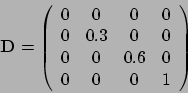
\begin{displaymath}\mathbf D = \left( \begin{array}{cccc}0 & 0 & 0 & 0\\ 0 & 0.3 &
0& 0\\ 0 & 0 & 0.6 & 0\\ 0 & 0 & 0 & 1
\end{array} \right)\end{displaymath}

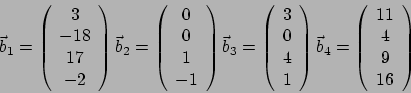
The next step is to calculate the Eigenvectors. They are shown below.

\begin{displaymath}\vec
b_1 = \left( \begin{array}{c}3\\ -18\\ 17\\ -2
\end{ar...
...4
= \left( \begin{array}{c}11\\ 4\\ 9\\ 16\end{array}\right)
\end{displaymath}

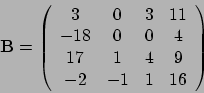
Thus B is the following :

\begin{displaymath}\mathbf B =
\left( \begin{array}{cccc}3 & 0 & 3 & 11\\ -18& 0 & 0& 4\\ 17& 1 &
4& 9\\ -2& -1 & 1 & 16
\end{array} \right)\end{displaymath}


MARTIN RAAB 2004-02-24